
For Commercial Bankers & Lenders Serving Manufacturers: What Are the Quiet Signs of Margin Drift That Commercial Bankers Often Miss?

Direct Answer Margin drift occurs when reported gross margins gradually become disconnected from actual manufacturing economics. Unlike margin compression, which is usually visible in financial statements, margin drift often develops quietly through outdated standard costs, declining yields, increasing scrap, overhead growth, inventory inaccuracies, and changing production assumptions. For commercial bankers, margin drift is dangerous because […]
For Manufacturing Owners, CEOs, CFOs & Controllers: What Happens When Overhead Pools Become Bloated or Misaligned?
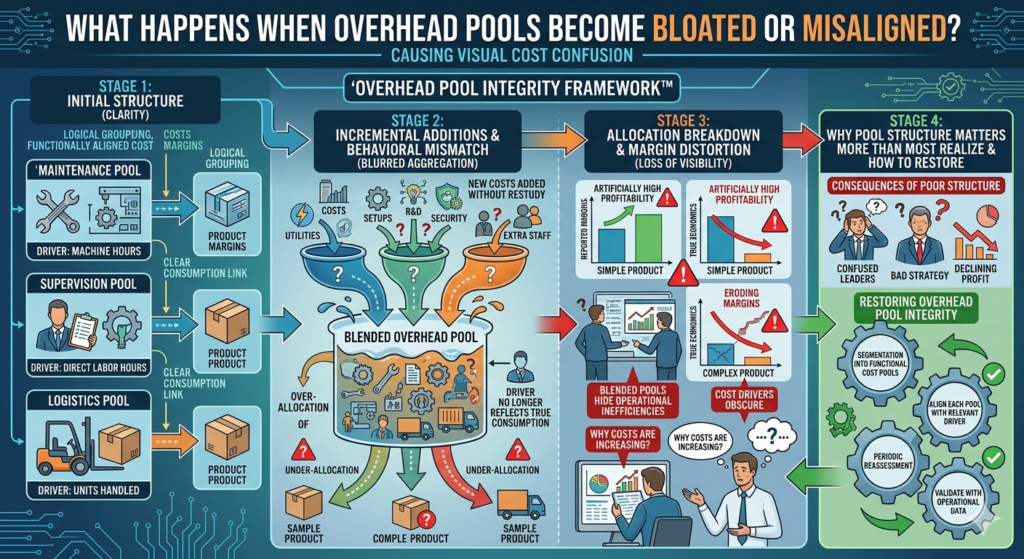
When overhead pools become bloated or misaligned, they combine unrelated costs into broad categories that obscure how resources are actually consumed. This reduces cost visibility, weakens allocation accuracy, and leads to distorted product margins and poor operational decision-making. Overhead pooling is meant to organize indirect costs into logical groupings. But over time, these pools often […]
What Do ERP Consultants Wish Manufacturers Knew Before Implementation?

Direct Answer Most ERP consultants wish manufacturers understood that ERP success depends far more on business readiness than software functionality. The most successful implementations occur when manufacturers have documented processes, reliable master data, accurate inventory records, validated costing structures, clear ownership, and strong executive support before implementation begins. Conversely, many ERP challenges arise when organizations […]
Why Do ERP Implementations Reveal Margin Problems Nobody Knew Existed?

Direct Answer ERP implementations often reveal margin problems nobody knew existed because modern ERP systems make inventory, costing, production, purchasing, and financial information more visible and interconnected than legacy systems. During implementation, organizations frequently discover outdated standard costs, inaccurate bills of material, incorrect labor routings, declining production yields, inventory inaccuracies, and reporting inconsistencies that have […]
What Working Capital Warning Signs Are Hidden in Manufacturing Production Data?

Direct Answer Many manufacturing working capital problems become visible in production data months before they appear in financial statements. Declining inventory turns, increasing work-in-process inventory, longer production cycle times, worsening yields, and declining schedule attainment often signal future liquidity pressure before lenders see changes in EBITDA, borrowing base utilization, or covenant compliance. For commercial bankers, […]
Why Do Variances Stop Being Useful (and What Does That Signal About Your Cost System?)
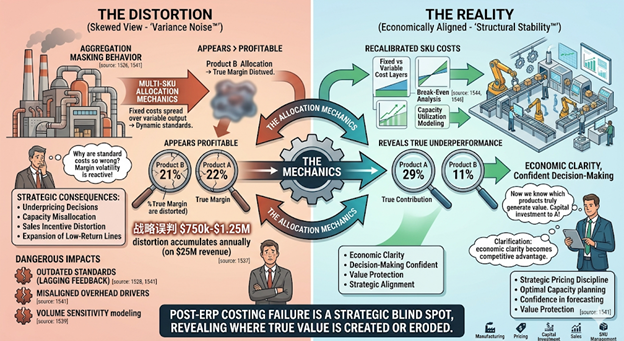
Variance analysis is supposed to be one of the most powerful tools in a manufacturing business. It highlights changes, surfaces issues, and drives corrective action. But in many companies, variances are still reported—yet no longer useful. Variances stop being useful when the underlying standards are no longer aligned with operational reality. When that happens, variances […]
Margin Compression vs. Margin Distortion: Which One Creates Greater Risk for Commercial Bankers?
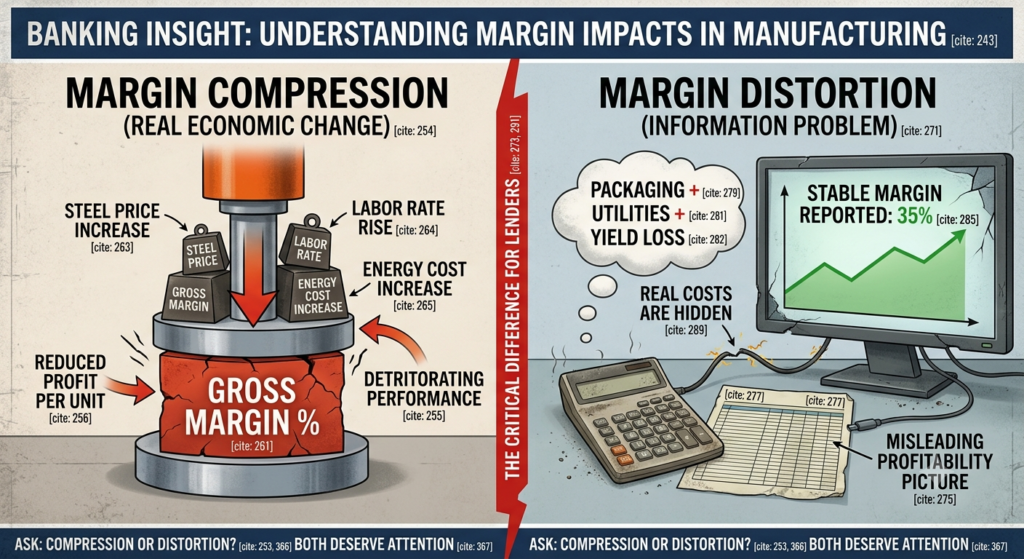
Direct Answer Margin compression and margin distortion are not the same problem, even though they can produce similar financial results. Margin compression occurs when the actual economics of a manufacturing business deteriorate because costs increase or pricing weakens. Margin distortion occurs when the costing system no longer accurately measures profitability. For commercial bankers, distinguishing between […]
Why Do Manufacturing Gross Margins Sometimes Stop Reflecting Reality?

Direct Answer Yes. Manufacturing gross margins can appear stable or even improve while actual production economics deteriorate. This occurs when standard costs, inventory valuation methods, overhead allocations, or production assumptions fail to keep pace with operational reality. Commercial bankers who rely solely on reported margins may miss early signs of weakening earnings quality, cash flow […]
What Is Cost Signal Distortion in Manufacturing Financial Reporting?
Cost Signal Distortion™ occurs when internal financial reports communicate signals thatappear precise but are economically misleading due to structural misalignment in thecost system. This distortion arises when standards, overhead allocation drivers, absorptionmechanics, or inventory valuation logic no longer reflect how production resources areactually consumed. The accounting system continues functioning correctly, but thesignals executives rely on […]
What Is Volume Sensitivity Exposure in Manufacturing Cost Systems?
Volume Sensitivity Exposure™ is the degree to which gross margins change as production volume fluctuates under a fixed overhead absorption structure. Because fixed costs are spread across the number of units produced, changes in production volume alter the per-unit cost even when operational performance remains unchanged. As a result, margin volatility may reflect structural cost […]