
For Manufacturing Owners, CEOs, CFOs & Controllers: What Happens When Overhead Pools Become Bloated or Misaligned?
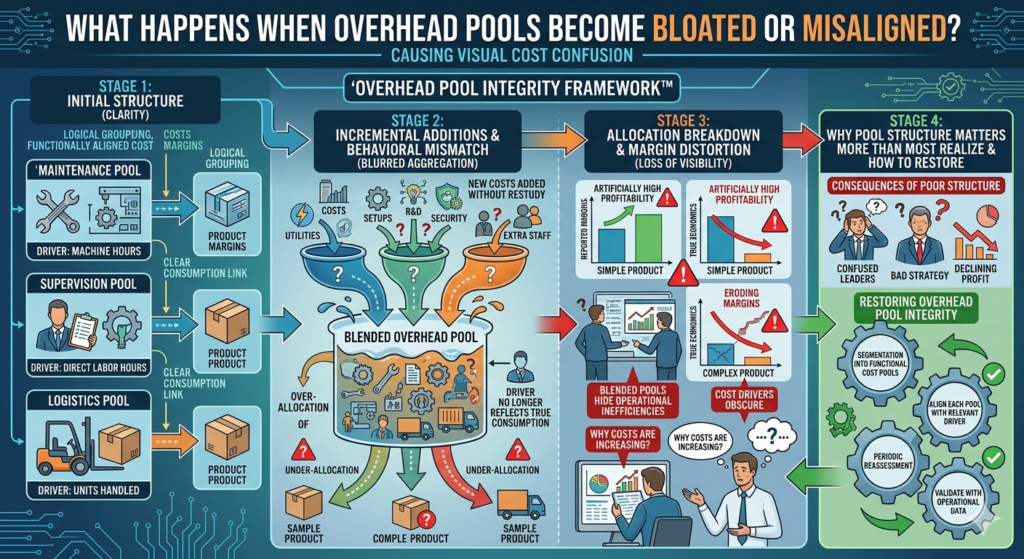
When overhead pools become bloated or misaligned, they combine unrelated costs into broad categories that obscure how resources are actually consumed. This reduces cost visibility, weakens allocation accuracy, and leads to distorted product margins and poor operational decision-making. Overhead pooling is meant to organize indirect costs into logical groupings. But over time, these pools often […]
For Manufacturing Owners, CEOs, CFOs & Controllers: How Do Poor Overhead Drivers Misallocate Costs Across Products?
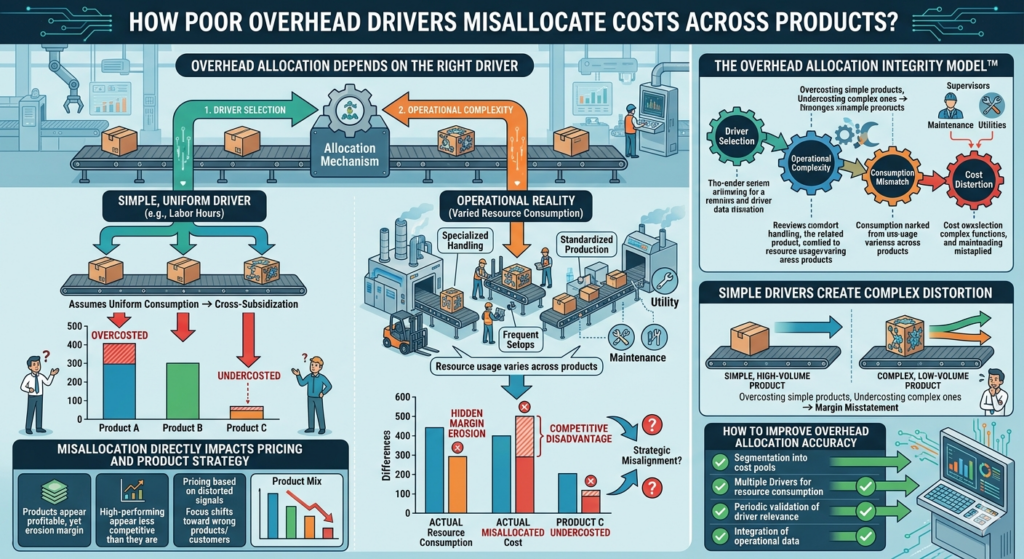
Poor overhead drivers misallocate costs because they assign indirect expenses using simplistic or outdated assumptions that do not reflect actual resource consumption. This causes some products to absorb too much cost while others absorb too little—resulting in distorted margins, incorrect pricing, and flawed product strategy decisions. Most manufacturers rely on overhead allocation to distribute indirect […]
What Are the Early Warning Signs Your Costing System Is Failing?
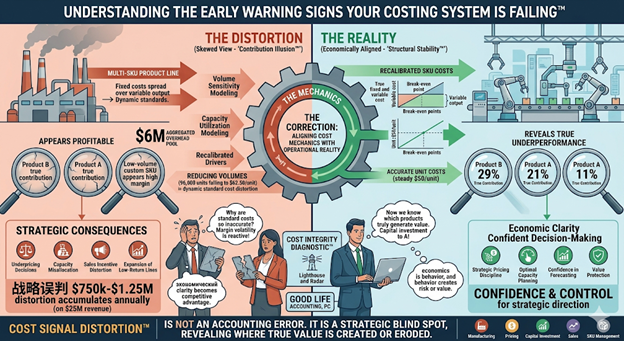
Most costing systems don’t fail all at once—they drift. The challenge is that by the time the problem is obvious, the financial impact is already embedded in your margins, inventory, and pricing decisions. The early warning signs of a failing costing system include stable but misleading margins, recurring unexplained variances, frequent inventory adjustments, and growing […]
Why Do Manufacturing Cost Systems Drift Without Executive Cost Governance?
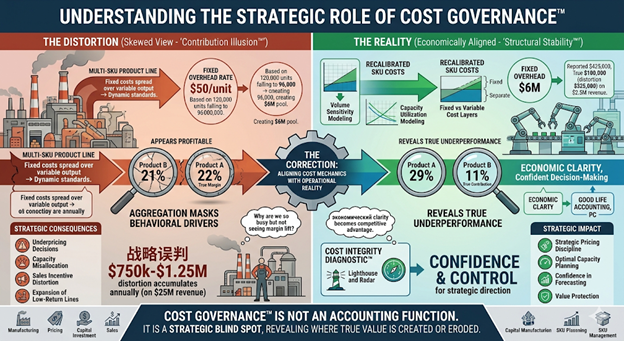
Manufacturing companies invest heavily in ERP systems, costing models, and financial reporting frameworks. These systems are designed to track materials, labor, overhead, and product margins with precision. However, as production environments evolve, the cost architecture that supports those reports often remains unchanged. Cost governance is the executive discipline of actively overseeing and periodically validating whether […]
Why Do Manufacturing Cost Reports Sometimes Send the Wrong Signals?
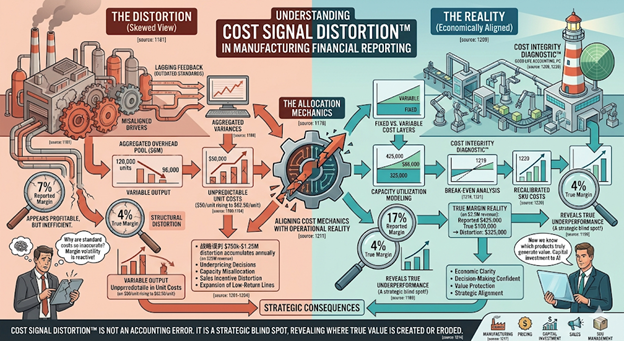
Manufacturing leaders rely on financial reports to guide pricing decisions, production planning, capital investment, and product strategy. Margin analysis, SKU contribution reports, and variance reports are designed to translate operational activity into clear economic insight. Cost signal distortion occurs when internal financial reports appear precise but communicate misleading economic signals due to structural misalignment in […]
Why Do Manufacturing Variance Reports Stop Providing Useful Insight?
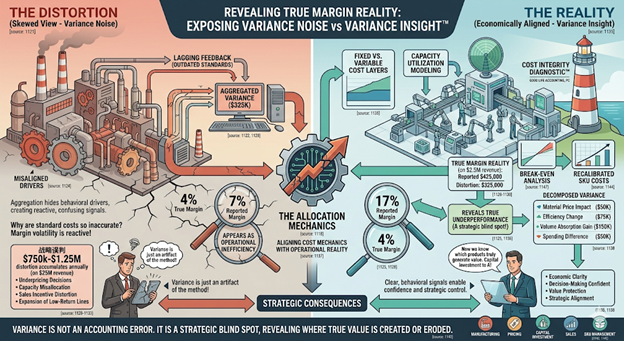
Manufacturing financial systems generate large volumes of variance data every month. Reports often include material price variance, labor efficiency variance, overhead spending variance, and production volume variance. In theory, these reports help management understand operational performance. Variance noise occurs when variance reports generate activity but not economic understanding. Instead of revealing meaningful changes in production […]
How Does WIP Compression Risk Distort Manufacturing Margins?
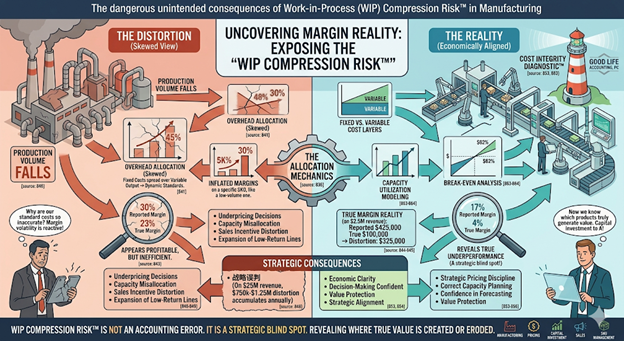
Work-in-process (WIP) inventory sits at the center of manufacturing financial reporting. It represents partially completed production that contains materials issued, labor applied, and overhead absorbed before the final product is finished. Because WIP sits between cost recognition and revenue recognition, even small valuation misalignments can affect reported margins. WIP Compression Risk occurs when work-in-process inventory […]
What Is Structural Instability in Manufacturing Cost Systems?
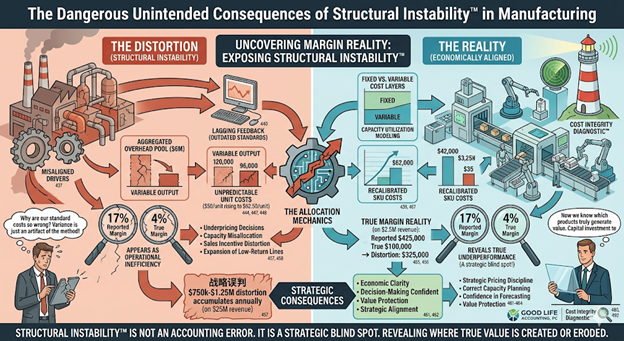
Every manufacturing company operates on an underlying cost structure that connects materials, labor, overhead, production flow, and volume behavior. This structure forms the foundation for pricing, margin analysis, and operational decision-making. Over time, however, businesses evolve while their cost systems often remain anchored to older assumptions. Structural instability occurs when a manufacturing cost system no […]
What Is Overhead Pool Inflation in Manufacturing Cost Systems?

Manufacturing overhead rarely stays static as businesses grow. Facilities expand, supervisory layers increase, indirect labor rises, and technology investments accumulate. These costs are typically grouped into overhead pools and allocated across products using absorption drivers such as labor hours or machine time. Overhead Pool Inflation occurs when manufacturing overhead expands but the allocation logic used […]
Why Do Standard Costs Become Stagnant in Manufacturing Systems?
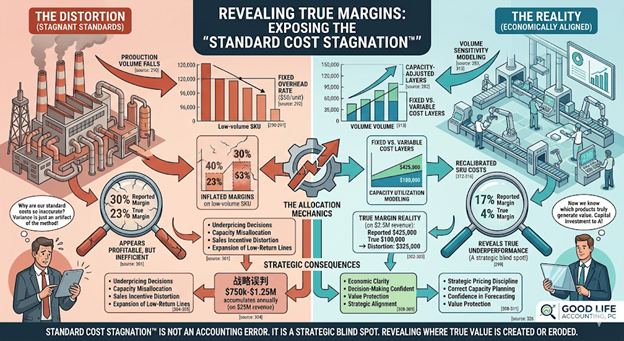
Standard costing is designed to create stability inside manufacturing financial reporting. It provides a consistent framework for measuring production efficiency, identifying variances, and evaluating profitability. However, production environments evolve continuously while standard costs are often refreshed infrequently. Standard Cost Stagnation occurs when standard costs are not updated in proportion to changes in materials, labor efficiency, […]