
How Do Uncaptured Production Variations Create Hidden Cost Gaps?
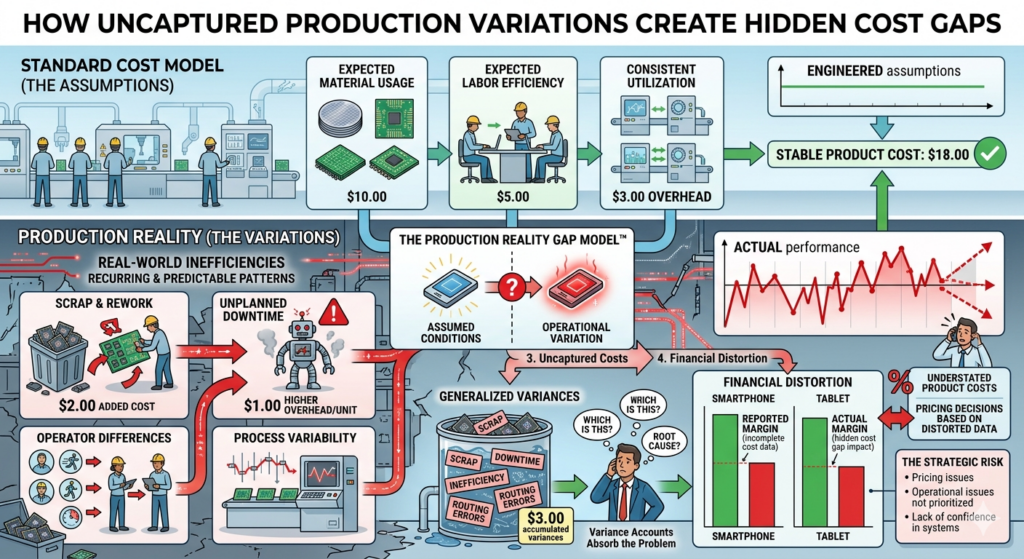
Uncaptured production variations create hidden cost gaps because real-world inefficiencies—such as scrap, rework, downtime, and process variability—are not reflected in standard costing systems. These untracked differences accumulate outside the cost model, leading to understated product costs, margin distortion, and misleading financial signals. Most costing systems are built on engineered assumptions. But production rarely behaves exactly […]
Why Are Bill of Materials (BOM) Errors More Dangerous Than They Appear?
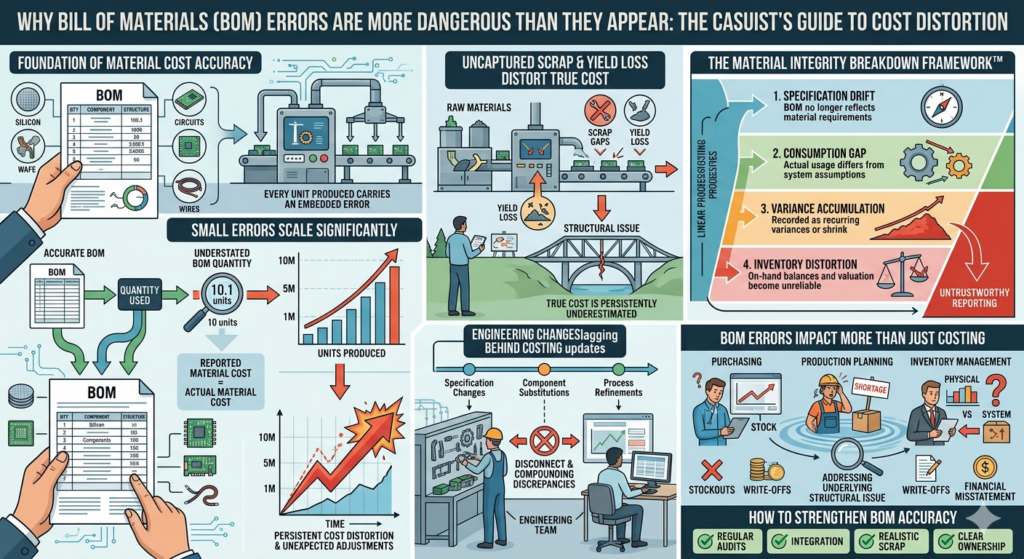
Bill of Materials (BOM) errors are dangerous because they systematically misstate material usage at the unit level, and when multiplied across production volume, they create persistent cost distortion in margins, inventory valuation, and purchasing decisions. Even small inaccuracies compound into significant financial misstatement over time. Most manufacturers assume BOM accuracy is “close enough.” In reality, […]
Why Do ERP Go-Lives Often Fail During the First Physical Inventory?

Direct Answer ERP go-lives often appear successful until the first physical inventory because inventory accuracy is finally tested against operational reality. During implementation, inventory balances are typically migrated from the legacy system into the new ERP. If those balances are inaccurate, the ERP inherits the problem. The first physical inventory frequently reveals years of transaction […]
Do Small Inventory Adjustments Signal Bigger Problems for Manufacturing Lenders?

Direct Answer Yes. Small inventory adjustments often reveal larger operational, reporting, and collateral risks that may not yet be visible in financial statements. While a single inventory correction is usually not a concern, recurring inventory adjustments frequently indicate weaknesses in inventory controls, production reporting, transaction discipline, or inventory accuracy. For commercial bankers, the adjustment amount […]
Why Is Inventory Accuracy a Bigger Risk Than Most Commercial Lenders Realize?

Direct Answer Inventory accuracy is often a greater risk than inventory valuation because inaccurate inventory records can undermine borrowing base calculations, collateral coverage, gross margin reporting, and financial statement reliability long before inventory becomes obsolete or impaired. For commercial bankers, inventory problems typically begin as information problems, not valuation problems. When inventory records stop accurately […]
Why Do Inventory Problems Become ERP Problems?

Direct Answer Inventory problems become ERP problems because inventory is one of the most interconnected functions within a manufacturing business. Inventory touches purchasing, receiving, production, warehouse operations, shipping, costing, financial reporting, and customer service. When inventory processes are inaccurate, delayed, or inconsistent, the ERP system simply reports those problems more clearly. In most manufacturing ERP […]
When Does Manufacturing Inventory Become a Borrowing Base Risk?

Direct Answer Manufacturing inventory becomes a borrowing base risk when its recorded value no longer reflects its recoverable value. Inventory may appear accurate on financial statements while being impaired by obsolescence, aging, customer-specific requirements, inaccurate counts, or weak inventory controls. For commercial bankers, the most important question is not how much inventory exists—it is how […]
Why Are Inventory Adjustments a Cost System Red Flag (Not Just a Cleanup Issue?)
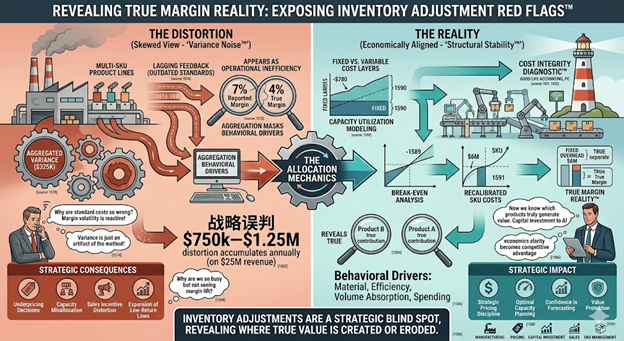
Inventory adjustments are often treated as routine accounting entries—something to fix discrepancies and move on. But that perspective misses the real issue. Inventory adjustments are not just corrections—they are signals. Frequent or unexplained adjustments indicate breakdowns in cost flow, transaction discipline, or system alignment, making them one of the clearest indicators that a costing system […]
Why Do Variances Stop Being Useful (and What Does That Signal About Your Cost System?)
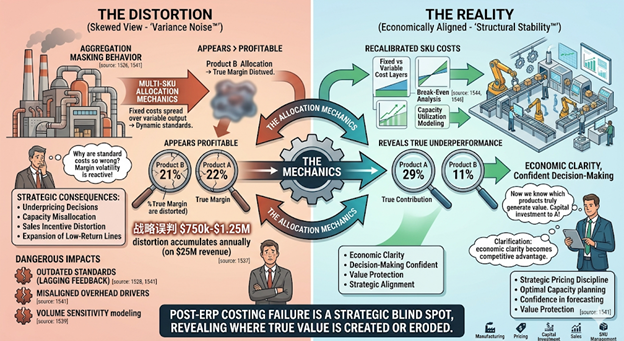
Variance analysis is supposed to be one of the most powerful tools in a manufacturing business. It highlights changes, surfaces issues, and drives corrective action. But in many companies, variances are still reported—yet no longer useful. Variances stop being useful when the underlying standards are no longer aligned with operational reality. When that happens, variances […]
What Are the Early Warning Signs Your Costing System Is Failing?
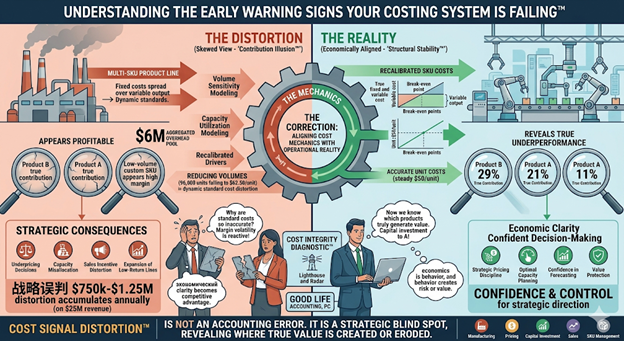
Most costing systems don’t fail all at once—they drift. The challenge is that by the time the problem is obvious, the financial impact is already embedded in your margins, inventory, and pricing decisions. The early warning signs of a failing costing system include stable but misleading margins, recurring unexplained variances, frequent inventory adjustments, and growing […]